


Matthew Higgins
It was April 2015 and I was driving down Canberra’s Tuggeranong Parkway intending to do a walk in Namadgi National Park. As I looked out to the ranges I was amazed to see snow, and lots of it, on Mt Gingera. Yes, and April! So my walk destination suddenly shifted to that majestic flat topped peak that broods over Canberra from the south-west.
I parked at Corin Dam and took the extremely steep Stockyard Spur walking track. Back when I first walked it in the 1980s it was a vague sort of footpad, but since the 2003 bushfires has been upgraded, even with steps in places. As I got above the steep initial climb and now ambled along the more gentling rising section of the spur I was soon amongst the snow. By the time I got to Pryor’s Hut there was a reasonable cover.
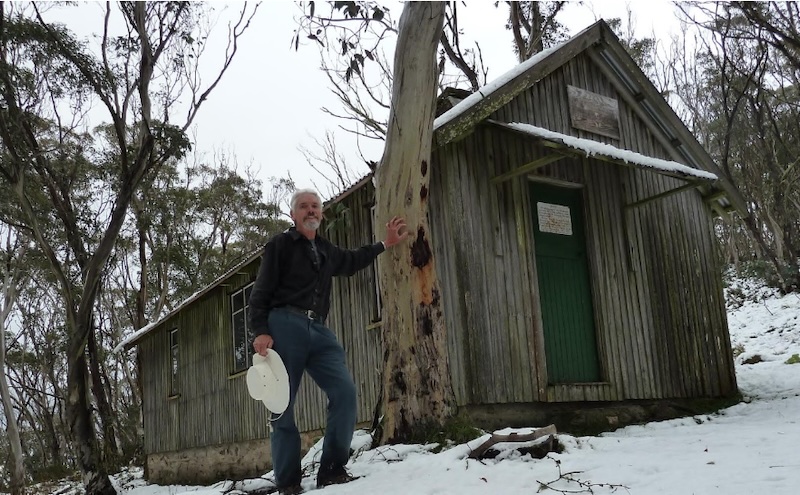
Whenever I visit Pryor’s I think of all the hours I spent with its namesake Lindsay Pryor, who had been head of Canberra’s Parks and Gardens Section before becoming ANU’s first Botany Professor. I interviewed Lindsay for several oral history projects. The hut which bears his name was built in 1952 as shelter for workers at the Alpine Botanic Garden on Gingera, a mountain annex to Canberra’s now famous Australian National Botanic Gardens which Lindsay established. Though the alpine garden eventually languished the hut serves to remind today’s visitor of Lindsay’s botanical vision all those years ago. On a number of occasions in the 1990s I led public bushwalks to the area and park rangers kindly drove aging Lindsay to the hut so that he could address the walkers about the alpine garden project.
My first Gingera climb was in June 1986. A bright, cold day full of promise. We walked up from Corin, had lunch at Pryor’s, and then several of us went on up to the summit. A chilly, south-westerly wind was blowing and the summit snowgums were lacquered with rime on their windward side. It was an intriguing natural ice phenomenon. Meanwhile, the members of our group who had stayed at Pryor’s had warmed themselves around a fire, and left a note stating that they had begun their descent, stating dramatically and with an Antarctic reference ‘Cold set in. Have eaten all huskies. Scott’! We all reconnected on the way down Stockyard Spur.
During my many summer walks around the peak, blue skies and sunshine have brought out myriad species of butterflies, like Spotted Alpine Xenical and MacLeay’s Swallowtails. Bogong Moths congregated in the rock crevices below the summit in thousands; they remain a strong link with Indigenous culture in the mountains when people like the Ngambri and Walgalu and visiting coastal and inland peoples traditionally scaled the peaks for food, ceremony, trade and marriage. Sub-alpine shrubs and wildflowers like Celmisia snow daisies, Wahlenbergia, Button Everlastings, golden Buttercups, purple Hovea and creamy Stackhousia brought colour amongst the snow grass and woodland. Amongst the sphagnum moss beds at Brumby Flat on the NSW side just below the summit I’ve found the runways of native Broad-toothed Rats and watched Copperhead snakes hunting for skinks.
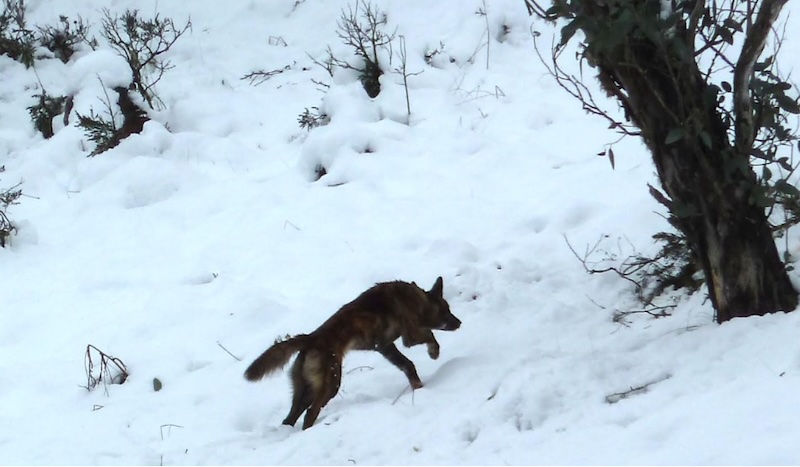
But back to the snowy day in April 2015: just past the hut a dingo stood on the snow-covered firetrail and stared at this out-of-season human coming its way. I gave it a howl and it loped off up the slope. Though its colouring was not the ‘traditional’ golden tan, modern research has shown that high country dingoes come in a range of colours. Soon it was time to leave the broad firetrail and head up the narrow foot track which takes you to the summit. By now the snow was quite deep. Of course I was in walking boots so just had to put up with feet that got increasingly wetter and colder. But there was no thought of discomfort as the amazing snowy views, with lowering cloud, surrounded me. Soon I was right on the summit amongst the granite slabs and boulders and gnarled snowgums that make this spot one of the most beautiful in the Australian high country. It is a place that has repeatedly drawn me back so many times over the last 40-odd years.
As it was a week day I had the summit, and indeed the whole walk, completely to myself.
It was a beatific hour or so taking in the views before I faced the descent. Down and along, back past Pryor’s, then gradually down the spur before the final steep descent to the dam. At one point along the spur I came upon a large snowgum branch which had fallen onto the track since my upward climb. You can be lucky sometimes.
And so this snowy April day was packed away with all the other memories I have of a beautiful mountain that we are so fortunate to enjoy in the ageless region that is Australia’s high country.